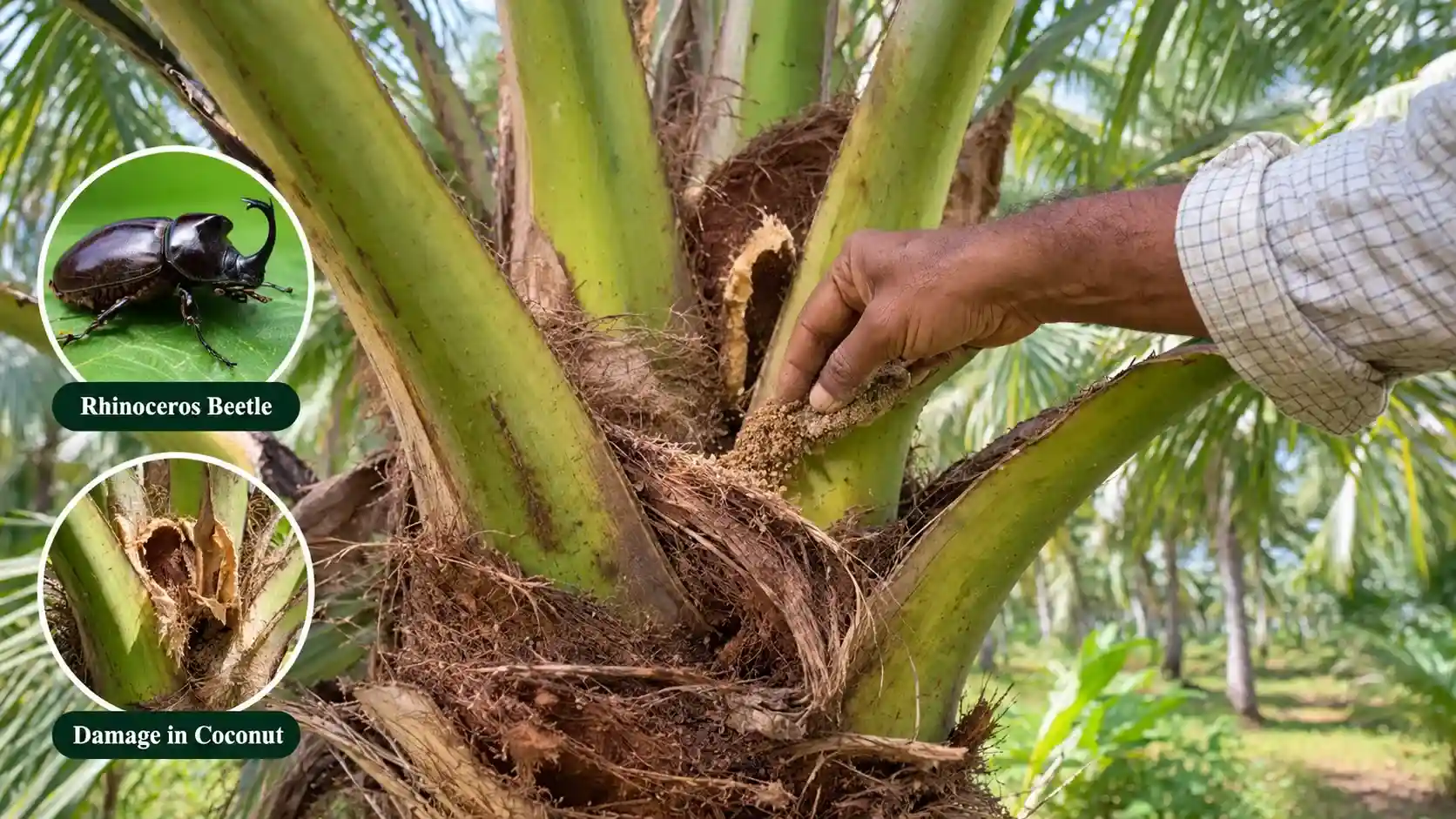
Crushed neem seed for coconut trees is commonly mixed with sand and placed in the innermost leaf bases of the crown, to help manage rhinoceros beetle damage. Tamil Nadu’s agricultural university lists neem seed powder with sand as one way to handle this pest. It works best when you also clean the places where the beetle breeds.
Ragged leaves on your coconut palms, again? Plenty of gardens go through this, and the cause is easier to find than most people think. At Organic Shakthi, coconut growers tell us about this problem often, so let’s go through it step by step.
What Does Rhinoceros Beetle Damage Look Like in Coconut?
The rhinoceros beetle is a big, dark insect, black or deep brown. The male has a horn on its head, which gives the beetle its name.
Adults settle into the crown and eat their way toward the tender growing part. The youngest leaf, still folded up in the center, is where the harm often shows first.
Here is what to look for:
-
Leaves that open with triangular or diamond-shaped cuts
-
Chewed, stringy fibre sticking out of the crown
-
A center leaf that looks cut through or has fallen over
The loss can add up. This pest has been linked to a yield drop of 10 to 15 percent, so a palm that should give 100 nuts may give 10 to 15 fewer.
Beetle wounds can also attract the red palm weevil, which may lay eggs in them. So dealing with the beetle also helps protect the palm from a second pest.
Why Does the Beetle Keep Coming Back Every Year?
Because the beetle does not spend its whole life on your palm.
It lays eggs in rotting material: manure pits, dead coconut logs and old stumps. The young grow up there, then fly off to healthy palms to feed.
This is the reason the damage seems to repeat each season. Treating the crown deals with beetles that are already feeding. The breeding spots keep making new ones.
How Farmers Use Crushed Neem Seed in the Coconut Crown
Neem seed is bitter and strong-smelling, and farmers in India have used it against pests for a long time. For the rhinoceros beetle, the idea is simple: put a neem and sand mix where the beetle likes to feed.
Where does it go?
It goes into the leaf axils. These are the small gaps where young leaves join the crown. Use the three innermost leaves, the ones closest to the center.
The simple method
-
Mix neem seed powder with clean sand. Use one part neem to two parts sand.
-
Measure about 150 grams of the mix per palm. This is the amount Tamil Nadu Agricultural University (TNAU) suggests.
-
Place it at the base of the three innermost leaves in the crown.
Field tests published in the International Coconut Community’s journal put this mix among the better options, partly because farmers can get both ingredients without much cost.
How often and when?
TNAU’s coconut guidance mentions applying the sand and neem mix once every three months. Please read their page and ask your nearest agriculture office before you set your own schedule, because rain and pest pressure differ from place to place.
For a rough guide to seasons, Kerala Agricultural University gives April to May and September to October as two windows for neem cake mixed with sand. That advice is for neem cake, not neem seed powder, so treat it only as a hint about timing.
One honest note: neem helps manage this pest. It does not promise that no beetle will ever visit your palm. That is why the steps below matter too.
What Else Helps Control Rhinoceros Beetles in Coconut?
Think of neem as one tool in a toolbox. These steps help it do its job:
-
Clear the breeding spots. Remove and burn dead coconut trunks and old stumps.
-
Search your manure pits. Digging one out? Look through it first. Grubs look like thick, pale worms that curl up in a “C”. Each one you destroy means one beetle fewer.
-
Hook out adults. When you harvest, check the crown. A metal hook can pull out beetles hiding inside.
-
Set traps. TNAU also lists pheromone traps and castor cake pots for catching adults.
If you use cow dung manure, keep the pit covered and check it often. A forgotten pit is a perfect nursery for beetles.
Common Mistakes Farmers Make
-
Treating only the crown. The beetles breeding nearby simply come back.
-
Putting the mix in the wrong place. It belongs in the leaf axils, not on the ground.
-
Doing it once and stopping. The beetle returns, so one round is rarely enough.
-
Expecting a perfect result. Neem manages the pest. It does not wipe it out for good.
Where Does Organic Shakthi Crushed Neem Seed Fit In?
Organic Shakthi offers Crushed Neem Seed for farmers and growers who want a natural input for their coconut palms. Use it as one part of your routine, along with clearing breeding spots and checking your crowns.
Not sure how much your palms need? Talk to Organic Shakthi.